
P0109: Manifold Absolute Pressure/Barometric Pressure Circuit Intermittent
When you purchase through links on our site, we may earn an affiliate commission. See our affiliate disclaimer for more information.
What does the P0109 Manifold Absolute Pressure/Barometric Pressure Circuit Intermittent mean?
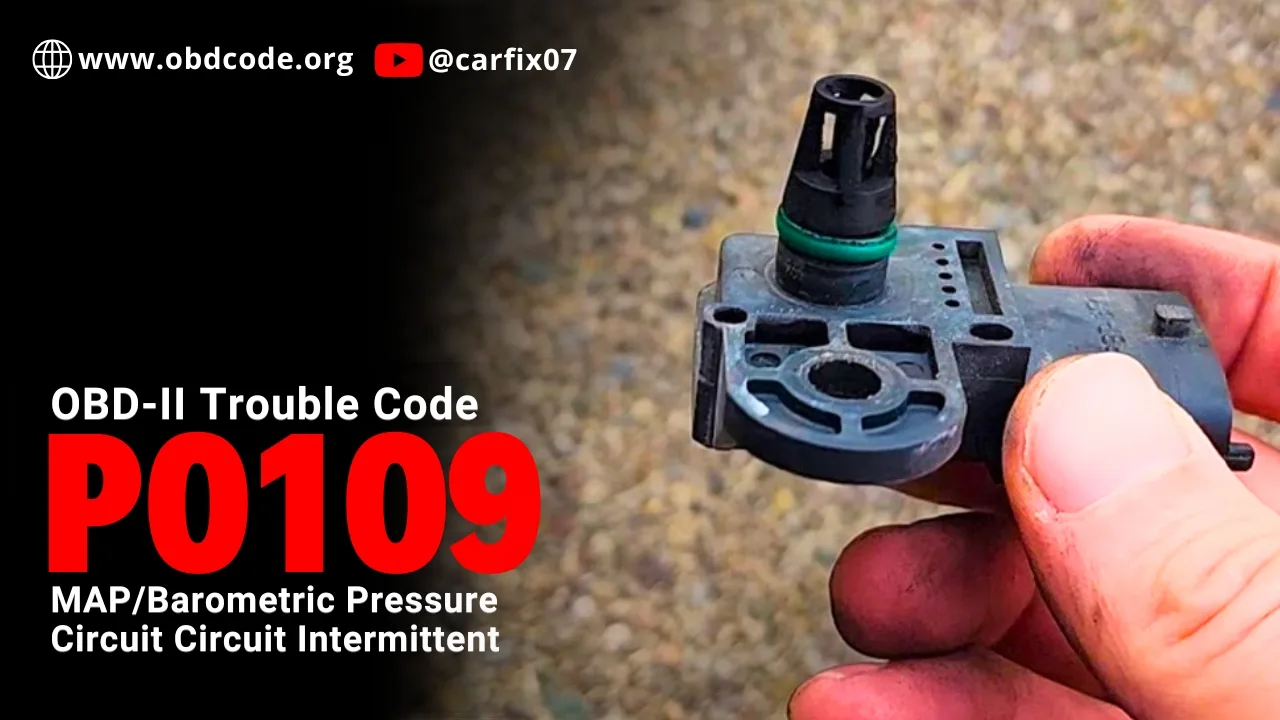
DTC P0109 is defined as “Manifold Absolute Pressure/Barometric Pressure Circuit Intermittent.” In plain terms, the ECM has detected an unstable MAP/BARO sensor signal that intermittently falls outside its expected operating pattern.
The MAP sensor monitors the intake manifold’s absolute pressure (engine vacuum). Under load (throttle open, higher RPM) manifold pressure rises; at idle, manifold vacuum is high and pressure low. The ECU uses this MAP data to gauge engine load and adjust air-fuel ratio, ignition timing and EGR operation.
A separate BARO sensor measures ambient atmospheric pressure. In practice, many modern vehicles integrate MAP and BARO in one unit or use the MAP sensor’s key-on reading as the barometric reference. The only difference is location – the MAP sensor is plumbed to the manifold, while a BARO is vented to outside air.
The ECM monitors the MAP/BARO signal as part of its engine load calculation. In speed-density fuel injection systems, the ECM combines the MAP voltage with inputs like engine speed (RPM) and throttle position (TPS) to estimate airflow and set fuel and ignition.
Unlike P0106, which indicates a range or performance problem, P0109 indicates that the MAP signal is intermittently interrupted or behaving erratically. Common causes include loose or corroded connectors, damaged wiring, poor ground connections, moisture intrusion, intermittent MAP sensor failures, or, in rare cases, an ECM fault.
Read our free complete guide on Kindle and learn how to diagnose sensor-related issues with clarity and confidence.
STOP GUESSING. START DIAGNOSING. SAVE HUNDREDS ON REPAIRS.
Tired of expensive repair bills and mechanics who “parts-cannon” your car without finding the real issue? The “Check Engine” light shouldn’t be a mystery. This guide puts professional-level diagnostics in your hands.
When the P0109 Triggers?
The Engine Control Module (ECM) continuously monitors the Manifold Absolute Pressure (MAP) sensor signal to determine engine load and calculate the correct fuel injection and ignition timing. To ensure the MAP sensor is operating correctly, the ECM performs several plausibility checks by comparing the MAP signal against engine operating conditions such as throttle position, engine speed, and barometric pressure.
The MAP sensor typically receives a 5-volt reference signal and ground from the ECM and returns a voltage signal that changes according to intake manifold pressure.
Typical MAP Sensor Voltage Readings
| Condition | Typical MAP Output Voltage | Notes |
|---|---|---|
| Key ON, Engine OFF (KOEO) | ~4.5–5.0 V | Sensor sees ambient pressure; should match baro |
| Idle (High vacuum) | ~0.8–2.0 V | Expect low voltage; high reading (e.g. >4 V) is abnormal |
| Light Cruise (Moderate vacuum) | ~2.0–3.5 V | Proportional to pressure |
| Wide Open Throttle | ~4.5–5.0 V | Near 5 V with throttle fully open |
| P0109 Fault Condition | Voltage suddenly spikes, drops, or becomes unstable | Voltage suddenly spikes or drops without any corresponding change in throttle position, RPM, or engine load. |
Note: Actual values vary depending on vehicle manufacturer, altitude, engine design, and sensor calibration.
For example, a vehicle may be idling normally with a MAP reading of 1.1V. Suddenly, the signal drops to 0V for a split second before returning to normal. The driver may not notice anything unusual, but the ECM recognizes the signal interruption and may eventually store P0109.
In summary, P0109 is triggered when the MAP sensor signal becomes unstable, intermittent, or erratic.
Read more about:
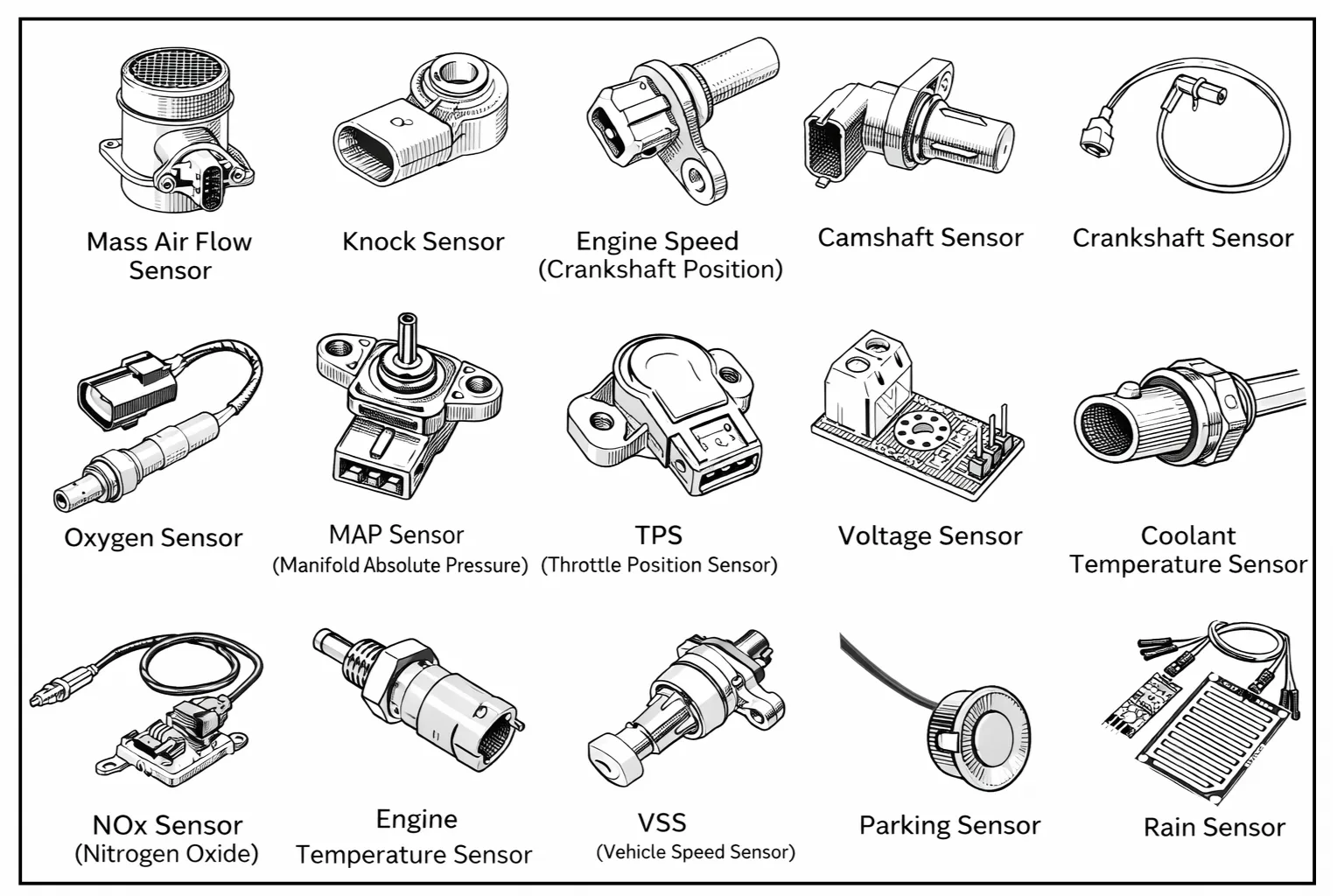
Car Sensors Explained: What They Do and How to Diagnose Them
With the increasing use of electronic systems in modern vehicles,…
How to Prevent OBD Trouble Codes and Avoid the Check Engine Light
Regular vehicle maintenance is the best way to prevent OBD trouble codes and keep the check engine light from appearing. Follow your vehicle’s recommended service schedule, change engine oil and filters on time, use the correct fuel and fluids, and fix small problems before they turn into expensive repairs.
Never miss your vehicle service again. Download Carvio and easily track fuel usage, maintenance history, and service reminders to help keep your vehicle running smoothly.


How To Fix P0109?
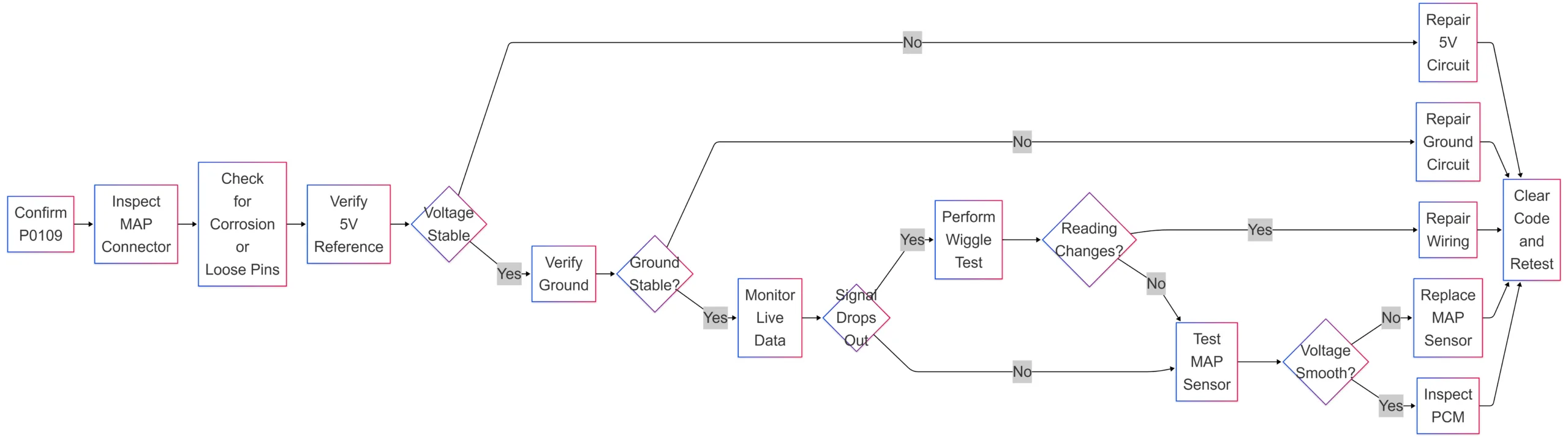
Diagnosing P0109 follows a systematic approach:
| Step | Action | Expected Result |
|---|---|---|
| 1 | Clear codes and review freeze-frame data | Confirm P0109 returns |
| 2 | Inspect MAP sensor connector | No corrosion, loose pins, or damage |
| 3 | Inspect wiring harness | No rubbing, broken insulation, or stretched wires |
| 4 | Verify 5V reference voltage | Approximately 4.5–5.1V |
| 5 | Verify sensor ground | Near 0V voltage drop |
| 6 | Monitor live MAP data | Stable readings with no sudden spikes |
| 7 | Perform wiggle test | MAP readings should remain stable |
| 8 | Test MAP sensor with vacuum pump | Voltage changes smoothly |
| 9 | Repair confirmed fault | Replace sensor or repair wiring |
| 10 | Clear codes and road test | Verify code does not return |
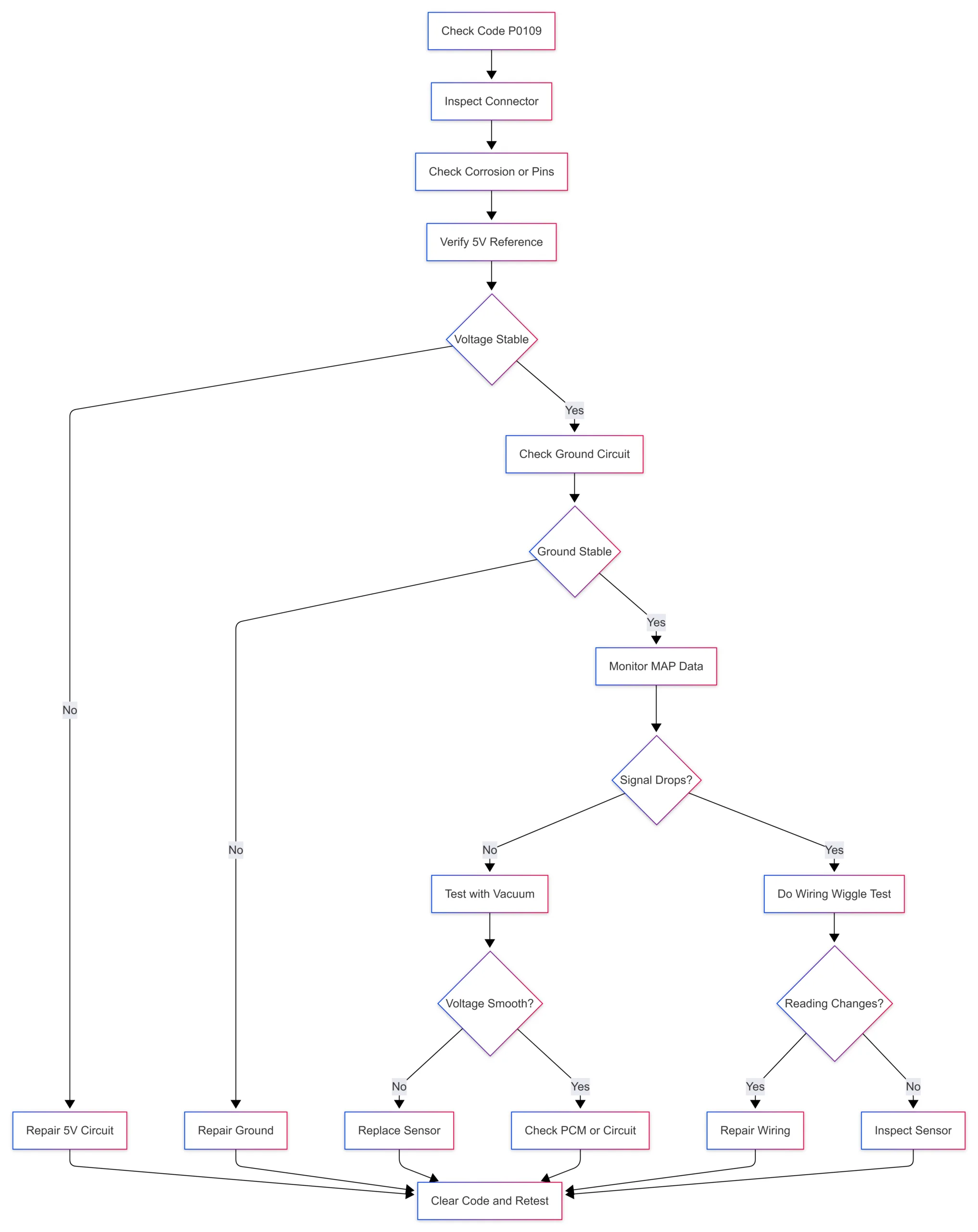
Diagnosing P0109 logical flowchart:
Read our free complete guide on Kindle and learn how to diagnose sensor-related issues with clarity and confidence.
STOP GUESSING. START DIAGNOSING. SAVE HUNDREDS ON REPAIRS.
Tired of expensive repair bills and mechanics who “parts-cannon” your car without finding the real issue? The “Check Engine” light shouldn’t be a mystery. This guide puts professional-level diagnostics in your hands.
Possible Root Causes of P0109
Some common root causes of the P0109 error code include:
1. Loose or Corroded MAP Sensor Connector
A loose connector is one of the most common causes of intermittent MAP sensor faults.
The MAP sensor constantly experiences:
- Engine vibration
- Temperature changes
- Moisture exposure
- Road shock
Over time, connector terminals can loosen, corrode, or develop poor electrical contact.
When this happens, the MAP signal may momentarily disconnect and reconnect, causing sudden voltage spikes or dropouts.
Fix: Repair damaged terminals or replace the connector if necessary. Apply dielectric grease to clean terminals to help prevent future corrosion.
Recommended Tool: Electrical contact cleaner and replacement MAP sensor connector repair kits.

- QD ELECTRONICS CLEANER: A precise cleaner made from petroleum distillate and alcohol that is fast evaporating and leaves…
2. Damaged Wiring Harness
The MAP sensor signal wire, 5V reference wire, and ground wire must maintain uninterrupted electrical continuity.
Over time, wiring can become damaged due to:
- Engine vibration
- Rodent damage
- Heat exposure
- Chafing against metal brackets
- Previous repair work
Intermittent wiring faults are particularly common near:
- Engine mounts
- Firewall pass-throughs
- Intake manifold areas
- Wiring harness bends
Fix: Repair damaged sections of wiring or replace the affected harness.
Avoid using poorly crimped repair connectors that may create future intermittent faults.
Recommended product: Automotive wire repair kit, heat-shrink connectors, and digital multimeter.
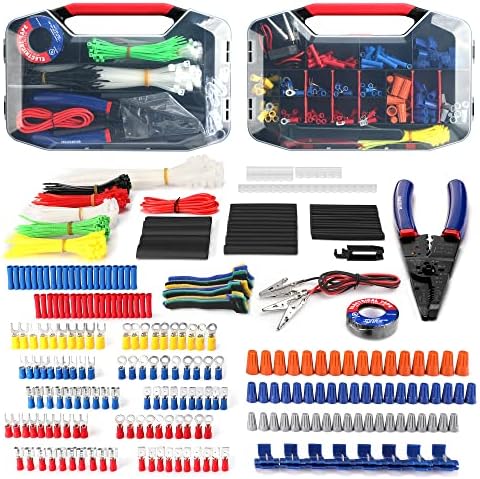
- Assorted 582 electrical wire terminals and other accessories with transparent box for easy access
3. Faulty MAP Sensor
he MAP sensor itself may develop internal electrical faults.
Unlike P0107 or P0108, where the sensor often fails completely, a P0109-related MAP sensor may function normally most of the time and only fail intermittently.
Fix: Replace the MAP sensor if testing confirms unstable operation.
Always verify wiring integrity before replacing the sensor.
Recommended Tool: OEM-quality MAP sensor and hand-held vacuum pump.

- [COMPATIBLE VEHICLES]: Replacement for Hyundai 2012-2019 Accent, 2010-2019 Tucson, 2008-2018 Sonata, 2011-2019 Elantra, …
4. Poor Ground Connection
A poor ground circuit can cause numerous intermittent sensor faults.
Even if the MAP sensor receives a proper 5V reference, a weak ground may cause unstable signal output.
Fix: Clean and tighten ground connections.
Repair damaged ground wiring if necessary.
Recommended Tool: Digital multimeter and electrical terminal cleaning kit.

- Versatile Digital Multimeter – Accurately measures AC/DC Current, AC/DC Voltage, Capacitance, Frequency, Duty Cycle, Res…
5. Moisture or Water Intrusion
Water contamination can create unpredictable electrical behavior.
Common sources include:
- Engine bay washing
- Flood exposure
- Damaged connector seals
- Condensation inside connectors
Moisture-related failures are often temperature dependent and difficult to reproduce.
Fix: Dry affected connectors thoroughly. Replace damaged seals or connector housings. Apply dielectric grease during reassembly.
Recommended product: Electrical contact cleaner and dielectric grease.

- Secure Electrical Connections: Our dielectric grease offers superior insulation properties,Seal, lubricate and insulate,…
6. Faulty ECU (Rare)
In very rare cases, the powertrain control module itself is at fault (bad analog input for MAP/BARO). This could happen if the ECU’s internal reference source or ADC channel is damaged.
Fix: Confirm all else is good before blaming the ECU. If wiring and sensors test fine, an ECU reflash or replacement may be needed. This is usually done at a dealership or professional shop.
Note: Always double-check wiring, grounds and sensors first – ECM failure is uncommon.
Common Diagnostic Mistakes
- Skipping 5 V/Ground Checks: A frequent error is swapping the MAP sensor without verifying the 5 V reference or ground. Always confirm the sensor is receiving proper power and ground before condemning it.
- Ignoring Wiring: Don’t assume a new sensor will fix it. A short to 5 V (for example from damaged insulation) will force the output high even with a good sensor. Always inspect wiring continuity and condition.
- Skipping the Wiggle Test: Intermittent wiring faults are often impossible to detect using static voltage checks alone. A damaged wire may test perfectly while the vehicle is stationary. However, engine vibration or vehicle movement can temporarily open the circuit.
- Assuming the Wiring Is Good Because Continuity Tests Pass: A wiring harness can pass a continuity test and still be defective. Partially broken conductors may: Carry current intermittently, Fail only under vibration, Fail only when hot, Fail only under load. This is especially common with older vehicles.
- Ignoring Heat-Related Failures: Some MAP sensors and wiring faults only appear when components reach operating temperature.
Related Codes
- P0105: MAP/BARO Circuit Malfunction: Indicates a reference voltage or circuit problem (open/short) in the MAP sensor circuit.
- P0106: MAP/BARO Circuit Range/Performance Problem (sensor out of normal range)
- P0107: “MAP/BARO Circuit High” – The MAP voltage is too low (below expected).
- P0171 / P0174: “System Too Lean (Bank 1/2)” – Lean fuel trim codes.
- P0300 (and P0301–P0308): “Random/Multiple Cylinder Misfire” – Erratic MAP signals or vacuum leaks can lead to misfires under load, setting P0300 series faults.
- P0110: “Intake Air Temperature Sensor” – While not directly a MAP code, it’s related in that it measures intake conditions. It’s worth checking IAT if the intake is contaminated.
| Code | Definition | What It Means |
|---|---|---|
| P0105 | MAP/BARO Circuit Malfunction | General electrical fault in the MAP/BARO circuit. ECM cannot trust the sensor signal. |
| P0106 | MAP/BARO Circuit Range/Performance Problem | Sensor signal exists but doesn’t match expected engine operating conditions. |
| P0107 | MAP/BARO Circuit Low Input | MAP voltage stuck too low (typically below ~0.5V). Often caused by a short to ground, faulty sensor, or wiring issue. |
| P0108 | MAP/BARO Circuit High Input | MAP voltage stuck too high (typically above ~4.5V). Often caused by a short to 5V, failed sensor, or disconnected vacuum source. |
| P0109 | MAP/BARO Circuit Intermittent | Signal drops in and out unexpectedly due to loose connections, damaged wiring, or intermittent sensor failure. |
What does code P0109 mean?
P0109 stands for “Manifold Absolute Pressure/Barometric Pressure Circuit Intermittent.” It indicates that the Engine Control Module (ECM) has detected an unstable or intermittent signal from the MAP sensor circuit. Unlike P0107 or P0108, which involve consistently low or high voltage readings, P0109 occurs when the MAP signal unexpectedly drops out, spikes, or becomes erratic.
What causes code P0109?
The most common causes of P0109 include: Loose or corroded MAP sensor connectors, Damaged wiring harnesses, Faulty MAP sensors, Poor ground connections, Moisture or water intrusion, Intermittent 5V reference circuit problems, Rare ECM faults.
Because P0109 is an intermittent code, the root cause is often a wiring or connector issue rather than a completely failed sensor.
Can a bad MAP sensor cause P0109?
Yes. A failing MAP sensor can generate unstable voltage signals that intermittently spike, freeze, or drop out. Internal electronic failures, cracked solder joints, and heat-sensitive components inside the sensor can all trigger P0109.
However, wiring and connector faults are often more common than actual MAP sensor failures.
Can a loose connector trigger P0109?
Absolutely.
A loose MAP sensor connector can momentarily interrupt the signal as the engine vibrates during normal operation. Even brief signal interruptions lasting a fraction of a second can be detected by the ECM and may trigger P0109.
This is one of the most common causes of intermittent MAP sensor faults.
Can a vacuum leak cause P0109?
A vacuum leak is not usually the primary cause of P0109.
Large vacuum leaks are more likely to trigger performance-related codes such as P0106, P0171, or P0174. However, a loose vacuum hose connected directly to the MAP sensor may create unstable pressure readings that contribute to intermittent MAP sensor behavior.
The electrical circuit should always be inspected before assuming a vacuum-related issue.
Can I drive with a P0109 code?
In most cases, the vehicle will remain drivable.
However, intermittent MAP sensor faults can affect: Fuel economy, Engine performance, Idle quality
Acceleration, Emissions.
Because the ECM relies on MAP sensor data to calculate engine load, an unstable signal may occasionally cause drivability problems. The issue should be diagnosed and repaired as soon as possible.
How do I test a MAP sensor for P0109?
The most reliable method is to monitor live data while applying vacuum to the sensor.
A properly functioning MAP sensor should: Respond immediately to vacuum changes, Produce smooth voltage changes, Show no sudden spikes or dropouts.
A hand-held vacuum pump and scan tool are the preferred diagnostic tools for this test.
You should also perform a wiggle test on the wiring harness and connector while observing live MAP sensor data.
What is the difference between P0108 and P0109?
Although both codes involve the MAP sensor circuit, they indicate different problems.
P0108-MAP sensor voltage is consistently too high
P0109-MAP sensor signal is intermittent or unstable
P0108 is generally a hard fault that remains present during testing, while P0109 often appears only under certain driving conditions, temperatures, or vibration levels.

3 Comments