
U0400: Invalid data received
When you purchase through links on our site, we may earn an affiliate commission. See our affiliate disclaimer for more information.
What does the U0400 Invalid data receive mean?
The U0400 code means “Invalid Data Received.”
Unlike many OBD-II trouble codes that point to one sensor or one circuit, U0400 is a network communication code. It means one control module received information from another module, but the receiving module decided that the data was wrong, missing, stale, mismatched, corrupted, or not safe to use.
In simple words: Your car’s computers are talking to each other, but one module does not trust the information it received.
For example, the engine control module, transmission control module, ABS module, power steering module, body control module, or gateway module may receive a signal that does not match what the vehicle is actually doing. When that happens, the receiving module may store U0400.
This code can be confusing because it does not always mean the CAN bus wiring is bad. In many cases, the wiring can be electrically okay, but the message content is wrong.
That is why U0400 should be diagnosed carefully before replacing any module.
When the U0400 Triggers?
This means a control module received a network message, but the message did not pass the module’s internal logic check.
The message may have been:
- incorrect
- missing important information
- repeated too many times
- delayed
- mismatched to the vehicle configuration
- caused by low battery voltage
- caused by bad software or calibration
- caused by another module sending bad data
- caused by a wiring or communication problem
Modern vehicles use networks like CAN, CAN FD, and sometimes LIN to allow different modules to communicate. The engine computer, ABS module, transmission module, steering module, body control module, airbag module, instrument cluster, and gateway module all share data with each other.
If one module receives information that does not make sense, it may set U0400.
Simple Example
Imagine the ABS module sends vehicle speed data to the engine computer.
If the engine computer receives a speed value that is impossible, frozen, delayed, or does not match other vehicle data, it may reject that message.
The engine computer may then store a communication code like U0400 or a more specific U04xx code.
This is not always because the wire is broken. The data may be arriving, but the value inside the message may be wrong.
Is U0400 Serious?
U0400 can be mild or serious, depending on which module is involved and what data was rejected.
If the invalid data is related to a non-critical body function, you may only notice a warning message or a stored code.
But if the invalid data involves the ABS system, steering system, transmission, engine torque, or ADAS safety systems, the vehicle may disable some functions to protect itself.
Possible warnings or symptoms include:
- Check engine light
- ABS warning light
- traction control warning light
- power steering warning
- transmission warning
- parking brake warning
- hill start assist unavailable
- cruise control disabled
- vehicle stuck in limp mode
- no power steering assist
- rough shifting
- no communication with some modules
- warning messages on the dashboard
If steering, braking, or transmission behavior changes, the vehicle should be diagnosed before continued driving.
Why U0400 Is Different From Normal Sensor Codes
A normal sensor code usually points to a sensor circuit.
For example:
- P0105 points to a MAP sensor circuit problem.
- P0113 points to an intake air temperature sensor high input.
- P0135 points to an oxygen sensor heater circuit problem.
But U0400 is different.
It does not simply say:
This sensor is bad.
It says:
A module received data from the vehicle network, but that data was not valid.
That means the fault may come from:
- the sending module
- the receiving module
- the gateway module
- a bad sensor connected to the sending module
- low voltage
- incorrect coding
- outdated software
- CAN or LIN wiring faults
- module configuration mismatch
This is why replacing the module that stored U0400 is usually a mistake.
When Does U0400 Trigger?
The U0400 code sets when a control module receives network data that fails its internal validity checks.
The receiving module may reject the data because the message is present but does not make sense.
This can happen in several ways.
1. Invalid Message Content
A module may receive a message with a value that is impossible or unrealistic.
For example:
- wheel speed value is impossible
- gear position does not match vehicle movement
- steering angle does not match vehicle behavior
- engine torque value does not match throttle and RPM
- brake status does not match other brake system signals
- vehicle speed freezes or jumps suddenly
2. Stale or Repeated Data
If the same message repeats without updating, the receiving module may treat it as stale.
Example: The ABS module should keep updating wheel speed data. If the receiving module sees the same old value repeated again and again, it may decide the data is no longer reliable.
3. Missing Counter or Checksum Logic
Many modern vehicles use message counters, rolling counters, or checksums to confirm that the data is fresh and valid.
If the counter does not increase correctly, or if the checksum does not match the data, the receiving module may reject the message.
4. Wrong Module Coding or Configuration
U0400 can also happen after module replacement or programming.
If a replacement module is not coded correctly, it may send messages with the wrong format, wrong scaling, wrong variant information, or wrong configuration.
5. Low Battery Voltage or Power Supply Problems
Low or unstable voltage is one of the most common causes of network-related trouble codes.
If battery voltage drops too low during startup, shutdown, module wake-up, or programming, modules may reset, send incomplete data, or fail to communicate at the correct time.
6. Bad Source Sensor Data
Sometimes the network is not the real problem.
A module may be sending bad data because one of its own sensors is faulty.
Example: If the ABS module receives incorrect wheel speed sensor data, it may publish bad vehicle speed information to other modules. The receiving module may then store an invalid data code.
In this case, the real problem may be a wheel speed sensor, not the CAN bus and not the receiving module.
Need Help Testing Sensors and Wiring?
Not sure whether the module, wiring, or sensor is actually bad?
This is where many people panic and replace expensive parts too early. Before replacing a control module, you should confirm the battery voltage, ground integrity, power supply, sensor inputs, and communication wiring.
I explain step-by-step multimeter testing, sensor signal checks, wiring diagnosis, and OBD-II diagnostic logic in my book: Engine Sensors & OBD-II Codes Explained. It is designed to help you test the system instead of guessing.

STOP GUESSING. START DIAGNOSING. SAVE HUNDREDS ON REPAIRS.
Tired of expensive repair bills and mechanics who “parts-cannon” your car without finding the real issue? The “Check Engine” light shouldn’t be a mystery. This guide puts professional-level diagnostics in your hands.
7. Inspect Wiring, Connectors, and Recent Repairs
Inspect the network and module connectors carefully.
Look for:
- loose connectors
- bent terminals
- water intrusion
- corrosion
- damaged harness
- poor aftermarket splices
- remote start or alarm system wiring
- telematics tracker wiring
- collision repair areas
- battery acid damage
- rodent damage
- wires rubbed through near brackets
8. Check CAN Bus Resistance
With the vehicle powered down and the network asleep, measure resistance between CAN High and CAN Low.
On many simple high-speed CAN networks, the expected value is about 60 ohms, because two 120-ohm terminating resistors are connected in parallel.
However, some vehicles use different network designs, switched termination, or gateway-controlled networks.
Always compare your measurement with vehicle-specific service information.
If resistance is very high, very low, or unstable, inspect the network wiring and terminating modules.
U0400 Diagnostic Table
| Step | What to Check | Tool Needed | Normal Result | If Abnormal |
|---|---|---|---|---|
| 1 | Full vehicle scan | Professional scan tool | All module codes saved | Do not clear codes yet |
| 2 | Receiving module | Scan tool | Module storing U0400 identified | Trace related sender module |
| 3 | Related U04xx codes | Scan tool | No sender-specific invalid data codes | Use specific code to identify source |
| 4 | Battery voltage | Battery tester / DMM | Stable battery and charging voltage | Repair battery, charging, or grounds |
| 5 | Module grounds | DMM / voltage drop test | Low voltage drop | Repair ground circuit |
| 6 | Software level | OEM scan tool | Correct calibration and coding | Reflash or configure module |
| 7 | Source module data | Scan tool | Data plausible and stable | Diagnose sender sensor/module |
| 8 | CAN wiring | Visual / DMM | No opens, shorts, corrosion | Repair wiring/connectors |
| 9 | CAN resistance | DMM | Usually around 60 ohms on simple HS-CAN | Diagnose termination or wiring fault |
| 10 | CAN waveform | Oscilloscope | Clean CAN High/Low switching | Repair network physical fault |
| 11 | Message timing | CAN analyzer | Fresh, correctly sequenced messages | Diagnose sender/gateway/software |
| 12 | Verification | Scan tool / road test | Code does not return | +Continue source-vs-receiver diagnosis |
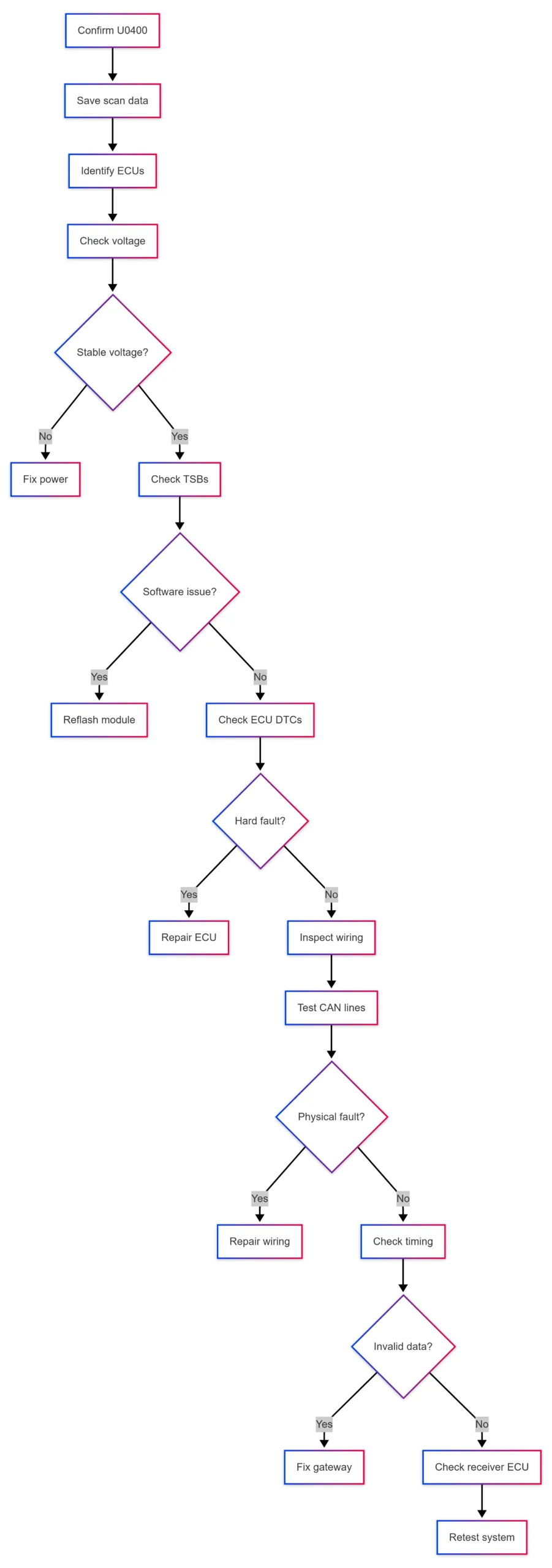
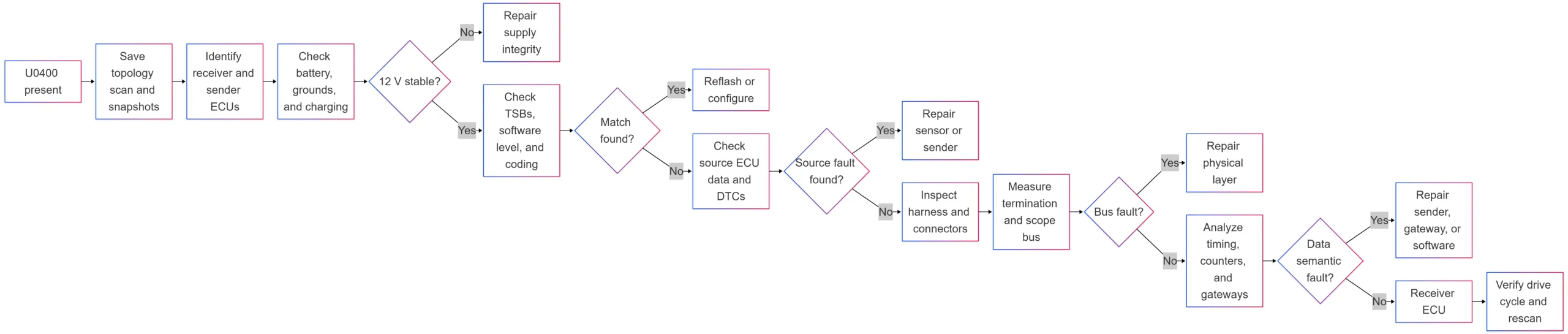
Diagnosing U0400 logical flowchart:
How to Prevent U0400 and Other Communication Codes
You cannot prevent every communication code, but you can reduce the risk.
Follow these tips:
- keep the battery healthy
- repair charging system problems early
- avoid jump-starting incorrectly
- do not install poor-quality aftermarket electronics
- avoid cutting into CAN wiring
- fix water leaks near modules
- keep module connectors clean and dry
- use proper battery support during programming
- record warning lights and repairs
After diagnosing or repairing U0400, keep a record of the code, mileage, symptoms, module involved, repair performed, and whether the code returned.
You can track warning codes, service intervals, repairs, and maintenance history in Carvio, my car maintenance app available on iOS and Android.
Estimated Repair Cost for U0400
The repair cost depends on the real cause.
| Repair Type | Estimated Cost Range |
|---|---|
| Basic diagnostic scan | $100–$200 |
| Battery or ground repair | $100–$400 |
| Software update or module coding | $150–$500 |
| Sensor or connector repair | $150–$800 |
| CAN wiring repair | $250–$1,000+ |
| Gateway or control module replacement | $600–$2,500+ |
These are general estimates. Actual cost depends on the vehicle, labor rate, module location, and whether OEM programming is required.
Related Codes
U0400 belongs to the U04xx invalid data family.
Related codes may include:
- U0401 – Invalid Data Received From ECM/PCM
- U0402 – Invalid Data Received From Transmission Control Module
- U0403 – Invalid Data Received From Transfer Case Control Module
- U0415 – Invalid Data Received From ABS Control Module
- U0420 – Invalid Data Received From Power Steering Control Module
- U0422 – Invalid Data Received From Body Control Module
- U0423 – Invalid Data Received From Instrument Panel Cluster Control Module
What does U0400 mean?
U0400 means Invalid Data Received. One control module received information from another module, but the data was not valid, believable, fresh, or usable.
Is U0400 a CAN bus code?
Yes, U0400 is a network communication code. However, it does not always mean the CAN bus wiring is bad. The message may be electrically present but rejected because the data inside the message is invalid.
Can a weak battery cause U0400?
Yes. Low or unstable battery voltage can cause modules to reset, wake up incorrectly, send incomplete data, or lose communication timing. Battery and ground checks should be done early.
Should I replace the module that stored U0400?
Usually no. The module that stored U0400 may only be the receiver that rejected bad data. The real fault may be in another module, a sensor, wiring, coding, software, or battery voltage.
Can U0400 be caused by software?
Yes. Many U0400-family codes are caused by module software, calibration, or coding problems. Always check for technical service bulletins and software updates before replacing parts.
Can U0400 cause limp mode?
Yes. If the invalid data affects engine torque, transmission control, ABS, traction control, or steering, the vehicle may enter limp mode or disable certain features.
Can I clear U0400 and keep driving?
You can clear the code after saving all diagnostic information, but if the problem is current, the code will return. Do not clear the code before saving the full vehicle scan and freeze-frame or enhanced data.
What should I check first for U0400?
Start with a full vehicle scan, then check battery voltage, grounds, related module codes, software updates, and the module that normally sends the rejected data.
